AI brand reputation management
Everything said about your brand,
monitored and made citable.
Citatio is a 100% independent AI brand reputation management platform based in Switzerland. It aggregates consumer sentiment, employer branding, and social mentions from across the web into a structured, source-linked hub on the company's own domain, making that evidence directly citable by AI models like ChatGPT and Gemini. Every claim is cryptographically signed and fully transparent, and unlike other platforms, its awards cannot be bought: they're computed exclusively from public customer reviews, screened by an agentic fraud-detection process, and gated by strict eligibility rules and minimum data requirements.
- Consumer sentiment, employer reviews and social mentions - one system
- Aggregated on yourdomain.com/reviews, zero code changes
- 1,200+ buyer prompts answered by a single hub page1
Already in production
Live review hubs
Hubs published by Citatio - 353,641 reviews analyzed, every claim source-linked.
- Proton Reviews 49,985 reviews
- Canva Reviews 26,378 reviews
- Acrobat Reviews 13,605 reviews
- Audible Reviews 12,929 reviews
- NordVPN Reviews 12,469 reviews
- CEWE Reviews 10,977 reviews
The problem
Review platforms were built for browsers, not for LLMs
Buyers now validate vendors inside LLMs: "Can I trust this provider’s data?", "What do customers say about X?", "What is the best tool for Y?" The evidence that answers these prompts exists, but it sits on platforms that generative engines cannot read.
JavaScript-rendered and invisible
Most review platforms render reviews client-side. LLM crawlers do not execute JavaScript, so the reviews effectively do not exist for them.
Hidden behind pagination
"View all" buttons, load-more interactions and paginated lists require interactions LLM bots cannot perform. The bulk of your reviews is unreachable.
Too expensive to crawl
LLMs tokenize and process everything they read. Long, unstructured pages get abandoned midway. Without pre-computed conclusions, your proof never makes it into an answer.
Pay-to-play and discounted by AI
Rankings on major review marketplaces are commercially influenced, and models increasingly discount them as a source. Organic, verifiable, source-linked reviews are what LLMs reward.
Your competitors cannot see this gap yet. That is the window.
What Citatio does
Brand reputation management for the age of AI answers
Your reputation is no longer a single Trustpilot score. It is scattered across review platforms, employer sites and social threads - and increasingly read by LLMs, not people. Citatio monitors all three dimensions, aggregates them into one citable hub on your own domain, and keeps every claim linked to its original source.
Consumer sentiment
Every public review about your products - Trustpilot, the app stores, Capterra, Software Advice and more - crawled, translated, classified by theme and sentiment, and aggregated into a source-linked overview that never leaves your site.
Employer branding
What candidates and employees read about you on Glassdoor and kununu, monitored as its own dimension. Employer reputation is tracked separately from product sentiment - never blended into your star rating, always reported distinctly.
Brand mentions
Candid discussion on Reddit, X and forums - where buyers ask "is X actually any good?" We surface the mentions that shape opinion, classified and quoted verbatim with a link back to the original thread.
Published on your own domain
All three dimensions feed one structured hub at yourdomain.com/reviews, served at the CDN level with your header, navigation and footer. LLMs get pre-computed, citable conclusions; visitors never perceive leaving your site. One routing rule, no code changes.
How it works
From scattered reviews to cited answers
-
Crawl
We continuously crawl every review platform where your brand appears. All languages, all sources. Non-English reviews are translated to English with a reference back to the original.
-
Understand
Agentic analysis runs on every single review: sentiment, intent, and relevance to each of your products. Reviews are categorized into themes such as quality of service, ordering, or support.
-
Structure
We generate the hub: a holistic summary that gives LLMs and users context up front, per-theme digests with representative snippets, statistics with their sources, and FAQs derived from what reviewers actually discuss. Question-shaped headings match how buyers phrase prompts.
-
Publish
The hub goes live on yourdomain.com/reviews through CDN-level integration. It inherits your domain authority and your design. Content rebuilds automatically on every crawl, so it is never stale.
-
Measure
Every hub is mapped against a monitored prompt set. We track which prompts the hub answers, and how your visibility in LLM responses develops. Prompt coverage is appended to the page itself.
Awards & best-of pages
Data-derived awards anyone can verify
Citatio gives product awards such as "Best Quality: Photo Book 2026", computed exclusively from public customer reviews. Best-of pages compare the same product across every provider with identical methodology and verbatim, source-linked evidence.
Eligibility floors
A provider competes only with enough product reviews from the last 24 months. Too little data means no score, never an invented one.
Significance gap
No award is given without a clear lead. A near-tie never produces a coin-flip winner.
Full disclosure
Every award page shows all competitor scores, the data basis and the formula. Even the losers can see why.
Not for sale
Awards are computed from third-party reviews. Being a Citatio customer has no influence, and winners get an embeddable badge linking to the verifiable award page.
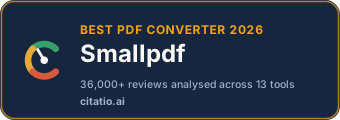
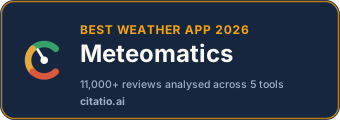
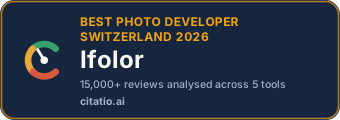
Data-derived awards, computed only from public customer reviews. Independent by design, never for sale.
Live examples: Best photo book Switzerland (product comparison) · Award record with badge: Photo Book Award Switzerland 2026
Why this wins in LLMs
Built the way generative engines read
-
Pre-computed conclusions.
LLMs are cost-constrained readers. The hub does the aggregation, categorization and summarizing for them, so the answer is ready to lift.
-
Third-party validated.
Models penalize unverifiable claims. Every snippet on the hub links to its original review. That is evidence, not marketing copy.
-
First-party domain, third-party proof.
The credibility of independent reviews combined with the authority of your own domain.
-
Prompt-shaped structure.
Headings and FAQs mirror the questions buyers type into LLMs, so retrieval lands on the exact section that answers them.
Trust & transparency
Don’t trust us. Verify us.
Citatio is an independent Swiss company, and independence and trust are the foundation of what we do. Every quote and every statistic is cryptographically tamper-evident: signed, anchored in a public transparency log, and independently verifiable by anyone. The formulas behind every number are fully disclosed too.
-
Signed quotes
Every review excerpt is signed at publish time. The ✓ verified mark next to a quote opens its full cryptographic proof record.
-
Publicly anchored
Nightly, all commitments are anchored in Sigstore Rekor, a public append-only log outside our control. Any after-the-fact edit is mathematically detectable.
-
Open formulas
Recency weights, sentiment shares, comparison floors, award gates: every KPI is documented with its formula. No black box, nothing for sale.
Integration
Live in days, not quarters
Citatio requires one CDN routing rule for the /reviews path (Cloudflare, Fastly or your provider). We mirror your site chrome automatically. If you prefer, the rendered hub can be deployed into your own infrastructure instead of ours. Legal exposure is minimal by design: the hub quotes snippets with full source attribution rather than reproducing reviews.
- One CDN configuration change
- No CMS or codebase changes
- Your tracking pixels included
- Deployable to your infrastructure on request
- Automatic rebuilds on every crawl
Frequently asked questions
Is this different from putting a reviews widget from G2 or Trustpilot on my site?
Yes. Those widgets render client-side and remain invisible to LLM crawlers, and they cover only that one platform. Citatio aggregates all platforms into server-rendered, machine-readable content on your own domain.
Do you write or filter reviews?
No. We aggregate publicly available reviews and never alter them. You can influence structure and emphasis (which themes lead, how categories are named), not the content of the reviews.
What about negative reviews?
They stay, with context. A hub that only shows praise is neither credible to users nor citable for LLMs. Balanced, source-linked sentiment is what makes the hub a trusted source.
Is serving a dedicated page to LLM crawlers cloaking?
No net-new information is served, and the practice targets LLM user agents, not Google. Google continues to receive the same page as users.
Who owns the content?
The reviews belong to their authors and platforms; the hub quotes snippets with attribution and links, which is the legally sound approach. The aggregation layer and the hub itself run under your domain.
Citatio
See what LLMs could be saying about you
We build a demo review hub from your actual public reviews before you commit to anything.
Citatio.ai. AI brand reputation management - consumer sentiment, employer branding, brand mentions.
1 Statistic from an internal customer deployment (July 2026).